How I Would Build a Case for Live Personalization in Your Next Event Brief
The most reliable driver of intentional dwell time at a premium event isn't the open bar, the photo moment, or the headliner — it's the one element almost nobody puts in the brief.
Live personalization creates curiosity and delight. When a guest watches something being made for them in real time, realizes the bottle they're holding will say something only they chose, placed exactly where they want it, with an illustration a machine couldn't produce, the reaction is surprise. And surprise is what makes people stop, stay, and pull out their phones.
The events industry is catching up to this. Freeman Company's research found that attendees who experience a peak moment are 85% more likely to return, yet only 40% say they've ever had one. (eventmarketer.com/article/imex-america-2025-takeaways) BizBash's recent reporting on dwell time confirmed that organizers consistently over-invest in multisensory environments while underdelivering on practical, hands-on engagement. (bizbash.com/event-production-planning/tips-for-designing-events-that-drive-dwell-time)
Live personalization, designed into an event correctly, is a peak moment by definition. It produces an object the guest chose to make, in a room they'll remember making it in.
Most event briefs treat the takeaway gift as a planning template line item rather than a strategic decision. The gift gets a purchase order. The moment that could make it mean something gets added two weeks before the event, or not at all. That's the brief gap, and it's where most activations lose what they could have been.
The Real Job of a Takeaway Gift
A florist gets a creative brief. A calligrapher gets a scope shift, a scope change, and then a side table.
That gap is worth examining, because what a florist is actually being asked in a brief conversation about peonies versus ranunculus isn't really about flowers. It's: will the brand's vision land in the room, or will guests just leave with a beautiful memory of well-arranged flowers?
When a guest leaves holding something that was made for them in that room, on that night, they aren't carrying swag. They're carrying a thread back to the experience. The engraved whiskey glass, the foil-stamped wallet, the monogrammed correspondence card — these become the reason a guest texts a friend the next morning: "do you remember when you wanted to put a dirty word on your mirror?" That's not a marketing outcome you can manufacture. It's what happens when the object was made personal enough to become a story.
I watched this work exactly as it should at a Pinterest dinner — I was one of several calligraphers brought in by the lead artist to support a “make your own snail mail kit” activation. Pinterest doesn't chase trends. They declare them, based on proprietary data, and that year's "not-yet-trending" forecast included brooches, pen pals, and cabbages. The florist wove brooch pins and cabbage flowers throughout the arrangements. Our station let guests build their own stationery sets — picking stickers, stamps, colored envelopes — while we hand-lettered their initials onto correspondence cards. The brief wasn't "add a calligrapher." It was: make the forecast tangible. Every element in the room, including ours, was executing the same message.
That's what a takeaway gift can do when it's designed into the brief rather than appended to it.
What Happens When It's in the Brief vs. Added After
The difference between an activation that works and one that doesn't isn't the artist — it's how seamlessly a guest can find her, engage, and walk away with something that feels like it belonged there all along.
At the Bath & Body Works holiday press preview at Nine Orchard Hotel, I was positioned in an alcoved area just off the entry hallway to the penthouse suite. Not a direct shot from the front door — guests had to round a corner to find me. A quarter of them walked past initially. But as I worked with my head down engraving, I could hear it traveling through the room: "what's going on here?" "like, on the bottle?" "omg what should I get on it?" By midpoint, guests who had already toured the full experience and filled their gift bags were circling back. The station hadn't been designed as a finale, but guest behavior made it one.
The misexecution version of this is more common: the artist is present, the product is there, but nothing in the room points to either. No signage. No staff who know to direct guests. A position that requires a guest to already know to look. Clarity doesn't diminish the magic of the moment — it protects it. A guest who spots the station from across the room and gets curious will have a better experience than one who stumbles onto it near the exit with a full gift bag already in hand.
Positioning and signage are brief decisions. So is assigning a staff member who knows how to talk about the activation. None of these are day-of improvisations — by then, it's too late to move the table.
Where I’ve Seen It Work for Different Formats
The format of your event determines what live personalization can do — and the brief should account for that before the artist is booked.
Three formats, three different briefs.
At an intimate dinner like the Four Roses bourbon press event — a dozen guests, one table — the activation doesn't need to compete for attention because there is no competition. Guests already feel prioritized. The small guest count meant every glass could be engraved without downtime, without a queue, without pressure. There was time for conversation while I worked. That kind of exchange — a guest watching their glass take shape while talking about why they chose what they chose — is what elevates a press dinner from a well-catered meeting into something a journalist actually writes about later. At an intimate dinner I worked for a foundation gala, we collected guest names during cocktail hour, worked through the full personalization list during the seated dinner, and had every piece waiting at the bar for guests to collect on their way out — three stages that made the activation feel seamless rather than squeezed.
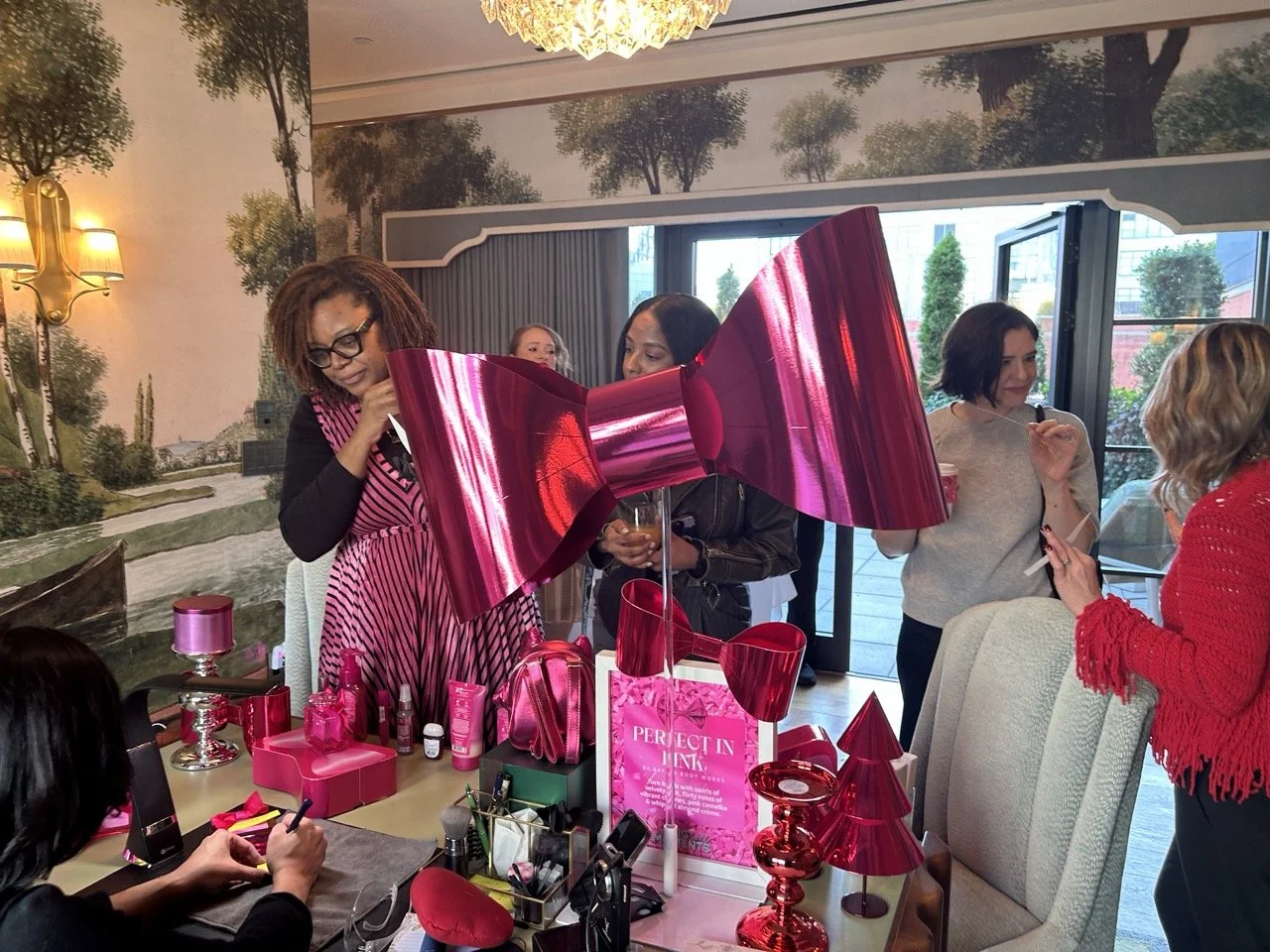
At a press preview or influencer event with no formal run of show, the activation works best when guests know it exists before they arrive. When customization is listed in the invite — "make sure you leave with one of our lipsticks engraved by..." — it becomes an intention, not a discovery. Guests who arrive knowing what to look for will find it.
At larger open-format events, the brief question that rarely gets asked is: what's the best way to get a return on bringing in a live calligrapher, and how do we make it just as interesting as the aura reader or the scent bar? Calligraphy is a quiet art. It isn't flashy. That means it needs brief-level fanfare — signage, staff direction, pre-event communication — because it won't announce itself the way a fog machine does. The investment in the vendor deserves the same investment in making sure guests find her.
The Big B Question
The budget objection almost always arrives after the brief is written — which is exactly why it's so hard to answer.
By the time a client says the activation budget hasn't been carved out for live personalization, the catering is confirmed, the venue is contracted, and the florals have a purchase order. There's no natural place to make room because the conversation happened too late for personalization to compete fairly with anything else on the sheet.
Live personalization is event duration, live entertainment, guest engagement, and a lasting keepsake built into a single line item. When it's in the brief from the start, it gets evaluated against what it actually delivers. When it arrives as a late addition, it gets evaluated against whatever discretionary budget remains — which is a comparison it was never meant to win.
The brands that find a way to make it work aren't necessarily spending more. They're deciding earlier. Immediate connection and artistry don't have to take a backseat. They just have to be in the room when the budget conversation starts.
Brief Decisions That Change Everything
A well-briefed artist isn't just easier to work with — she becomes a contributor to the event's outcome rather than a vendor executing instructions at the last minute.
The first brief decision is defining what the personalization moment is doing in the guest journey — finale, ambient presence, cocktail hour anchor. Without that answer, placement defaults to whatever space is left, and space that's left is never the right space.
The second is getting the creative brief to the artist early. Not the week before — early. Late briefing produces day-of failures that no amount of talent can solve: a station positioned away from the only outlet the engraving tool needs, a vegan leather that won't take gold foil because nobody tested it in advance, a lettering style chosen for elegance that reads as stiff against a modern graphic event aesthetic. These aren't execution failures. They're brief failures that arrived too late to fix.
The third is owning signage and staff direction. One staff member who knows how to tell guests about the activation. Signage that makes the station findable. Neither requires budget. Both require someone to put them in the brief.
When a client brings me into the conversation early, I can interpret what they're building and offer something back — why one material works better than another for their specific event, how to incorporate the activation in a way that serves the guest journey rather than interrupting it. That's not steering the creative direction. That's what early briefing makes possible. (bizbash.com/corporate-swag/5-tips-for-incorporating-live-calligraphy-engraving-into-your-event)
The events that work — where the activation lands, the guests linger, and the room feels like it was designed with intention — have one thing in common: you can feel it before the first guest arrives.
Not because everything went perfectly in planning. Because everyone who touched the brief knew what they were building toward.
Live personalization isn't a trend. It's the thread woven through the fabric of the event — the element that connects the brand's story to the guest's memory, that turns a gifted object into a reason to text a friend the next morning, that gives a press preview its organic social moment without manufacturing one.
The industry is already moving in this direction. Attendees are telling researchers they want hands-on, breakthrough experiences over flashy entertainment. (eventmarketer.com/article/imex-america-2025-takeaways) Brands are learning that loyalty outlasts virality. (thebeautybriefunpolished.substack.com/p/trend-fatigue-is-realmaybe-thats) The brief is where that knowledge becomes action.
If you have an event in planning and personalization isn't in the conversation yet, that's the place to start. Not as a line item to evaluate after everything else is confirmed — as a creative decision that shapes what the event is trying to do and how guests will feel when they leave holding something that was made for them in that room.
That's what belongs in the brief.